Walk through a desert, and the greenery surprises you. Everything looks like it shouldn't be there.
The sand is hot, the air is dry, and rain might not fall for months. Yet cacti stand tall, succulents gleam, and shrubs push down roots that stretch dozens of feet underground.
These plants aren't just tough — they've evolved some of the most specialized survival strategies in the plant kingdom.
The Three Core Strategies
Desert plants generally use one of three approaches to deal with almost no water: succulence, drought tolerance, or drought avoidance. Succulent plants store water directly in their tissues — in their leaves, stems, or roots. All cacti are succulents, and so are agave, aloe, and many euphorbias. This storage habit requires some companion adaptations.
Their stomata — the tiny pores through which plants exchange gases — stay closed during the day to prevent water loss and only open at night. This is called the CAM process, and it allows the plant to collect carbon dioxide in the dark and store it chemically for photosynthesis once the sun is out, all while minimizing evaporation. The thick waxy coating on their surfaces adds another layer of protection, slowing moisture loss even further.
The Saguaro's Hidden Tank
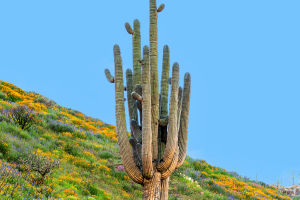
The saguaro cactus is the extreme example of this. Its trunk and arms are pleated like an accordion, which allows it to physically expand and contract as its water reserves fill or deplete. After rain, a mature saguaro fills its internal storage to the point where it can hold over a thousand gallons of water — and then draw on that supply for an entire year of drought.
The roots are shallow and wide, designed to intercept even brief, light rainfall before it evaporates. This combination of shallow roots, enormous storage capacity, and impermeable skin makes the saguaro one of the most effective water-collection systems in nature.
Going Deep Instead
Not all desert plants store water above ground. Drought-tolerant species like mesquite take the opposite approach and simply reach deeper. Mesquite roots have been documented extending well over 50 feet below the surface, tapping into underground water sources that surface rainfall never reaches.
The tree itself has small leaves — reducing the surface area available for water loss through transpiration — and a thick, waxy coating that slows moisture evaporation further. Creosote bush operates similarly, with deep roots and leaves coated in a resinous film that essentially seals in moisture even during the hottest desert afternoons.
These plants don't store water so much as they continuously access it, maintaining connection to reservoirs that drought never touches.
The Fast-and-Done Strategy
Then there's a completely different playbook used by annual desert plants. Rather than building elaborate water-storage or deep-root systems, these species race through their entire life cycle during the brief wet season.
They germinate, grow, flower, seed, and die — sometimes in just a few weeks — producing huge quantities of seeds that remain dormant in the soil for months or years, waiting for the next rainfall. This is a bet on timing rather than physiology. The plant itself is temporary, but its seeds persist.
Small Leaves, Big Advantage
Across almost all desert plant strategies, one physical trait shows up repeatedly: small leaves. Leaf surface area directly determines how much water a plant loses through transpiration. Smaller leaves mean less evaporative surface, and a smaller leaf in direct sun stays cooler than a large one, further reducing water loss.
Some desert plants, like junipers, take this to an extreme — their leaves are reduced to tiny, waxy scales wrapped around the branch. In the most severe droughts, some species drop leaves entirely and go dormant, reducing water loss to near zero by eliminating transpiration entirely.
Climate and the Future
Rising global temperatures are adding pressure to these already-extreme adaptations. As temperatures increase, soil moisture evaporates faster and the window of water availability shrinks. Flash floods, which desert plants have historically relied on for their seed-dispersal and root-soaking moments, are becoming less predictable.
Even the most evolved desert-survival strategies have thresholds, and if temperatures continue climbing, even the saguaro and mesquite may face conditions outside the range their adaptations were built for.