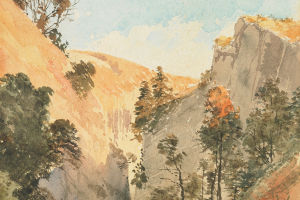
When we begin outdoor painting, we often feel overwhelmed by everything in front of us. Too many trees, too many colors, too many details. We want to draw everything, but the result often looks messy and unclear.
In this guide, we will walk through how we can simplify what we see, choose better scenes, and build stronger compositions. The goal is simple: help us capture the most beautiful moment with clarity and intention.
Why framing matters in painting
Framing is not just about “cropping” a scene. It is about choosing what matters and leaving out what does not support the story of our artwork.
- First, it helps simplify complex environments. Nature is rich and full of details, but copying everything often creates confusion in the final painting.
- Second, it helps us highlight the main subject. By selecting key elements, we guide the viewer’s attention naturally.
- Third, good framing improves rhythm and balance. It gives the artwork a visual flow, making it more pleasant to look at.
So, framing is actually a decision-making process that shapes the entire painting from the start.
Basic tool we can use: the framing window
A simple and powerful tool we can use is a framing window. We can make one using our hands by forming a rectangle with thumbs and index fingers.
By moving our hands closer or farther, we can test different compositions instantly. It helps us “preview” the painting before we even start.
This method prevents us from including too many unnecessary details. It also trains our eyes to notice stronger compositions faster.
When we go outdoors, we can practice this regularly. Over time, we naturally become better at selecting scenes without needing the tool.
Core composition methods we should know
There are several simple composition rules that can guide us.
- The first is the rule of thirds. We divide the scene into three equal parts horizontally and vertically. Placing the main subject near intersection points often creates balance and interest.
- The second is proportional balance. We can use natural ratios to position key elements, making the image feel more visually pleasing.
- The third is dynamic direction lines. These are invisible lines formed by paths, rivers, or natural movement. They help guide the viewer’s eyes through the painting.
We should not treat these rules as strict laws. Instead, we use them as flexible tools to improve structure.
Creating a clear visual focus
Every painting needs a visual center. Without it, the viewer may not know where to look first.
We can create focus in several ways.
- Color contrast is one method. A brighter or warmer area can naturally draw attention.
- Light and shadow also play a strong role. A well-lit subject against softer surroundings becomes more noticeable.
- Shape contrast works as well. A unique or larger form stands out against simpler shapes.
Usually, one or two focal points are enough. Too many focal points can weaken the overall clarity.
Simplifying what we see in nature
One of the most important skills is learning what to leave out.
- We do not need to include every branch, stone, or detail. Instead, we choose what supports the main idea.
- Complex shapes like trees or rocks can be simplified into clearer forms. This helps the painting feel more unified.
- We also focus more detail on the main subject while keeping other areas softer and simpler.
This balance between detail and simplicity makes the artwork more expressive and readable.
Understanding space with atmospheric perspective
To create depth, we can use atmospheric perspective.
- Objects that are close to us should appear clearer, sharper, and more detailed. Their colors can also be stronger.
- Mid-distance elements carry moderate detail and softer tones.
- Far-away elements become lighter, cooler, and more blurred.
By organizing space this way, we create a natural sense of depth that feels realistic and immersive.
How we choose the best starting point in complex scenes
When we face a complicated landscape, we should not rush in.
- First, we observe light changes. Light defines mood and time, so it is always the best starting point.
- Next, we simplify color relationships. Instead of using every tone we see, we identify the main color harmony.
- We also try to capture the moment quickly. Light and atmosphere can change fast, so timing matters.
Good observation is the foundation of strong artwork.
Different scenes need different framing approaches
Open landscapes like mountains or lakes benefit from wide compositions and balanced spacing.
Detailed environments like gardens or wooded areas work better with partial views and directional lines.
Architectural or cultural spaces benefit from symmetry and perspective structure.
By adjusting our framing method based on the scene type, we improve results more efficiently.
Adding emotion to our composition
Painting is not only about what we see, but also what we feel.
- We can express emotion through color temperature, light shifts, and composition choices.
- We can also bring personal interpretation into the scene instead of copying it exactly.
- When a painting tells a small visual story, it becomes more engaging and meaningful.
Common challenges and simple fixes
If our painting feels flat, it usually means we are missing depth. We can fix this by clearly separating foreground, middle, and background.
If the painting feels messy, we may have included too many details. In that case, we return to the main subject and remove distractions.
If we feel lost in a complex scene, we start by finding one strong focal point and build around it step by step.
Final thoughts for us
Framing is not just a technical step. It is how we see the world before we paint it.
When we learn to simplify, observe, and choose carefully, our paintings become clearer and more expressive.
Next time we go outdoors with a sketchbook, let’s not try to draw everything. Instead, let’s find the best moment and frame it with intention.
What kind of scene do we usually struggle with the most when painting outdoors?