Most people treat watering as a casual chore, but from a botanical perspective, you are managing a high-stakes biological water-transport system.
More indoor plants die from "systemic saturation"—root rot—than from dehydration.
When you water on a rigid, uncalibrated schedule, you are creating a structural bottleneck for oxygen, effectively suffocating the root zone. To keep your green specimens functional in a low-circulation indoor environment, you must abandon guesswork. You need a rigorous "SOP" grounded in plant physiology and soil science to ensure that your plant's vascular system remains operational without failure.
Assessing Soil Tension
Determining when to intervene requires more than a visual scan of the leaves. You must establish a physical audit of the "moisture tension" within the substrate. Indoor environments lack high evaporation rates, so the drainage speed affects oxygen availability for the roots.
The most reliable diagnostic tool is the "manual depth probe." Insert your finger at least 3–5 centimeters into the soil. If the tip detects any moisture, the capillary pores are still occupied by liquid, and adding more water will increase the risk of root rot.
For larger specimens, monitor the "soil-to-container gap." When the soil shrinks and pulls away from the walls of the container, the capillary action has reduced significantly, signaling a possible need for watering.
You can also utilize the "mass-ratio method"—simply lifting the container. A dry specimen feels significantly lighter than a saturated one.
The Hydration SOP
Precision watering is about "permeation efficiency," not volume. Dumping water quickly onto the surface creates "preferential flow," where the liquid bypasses the root ball and exits the drain holes immediately, leaving the core dry.
Hydration Calibration Checklist
- Thermal Stabilization: Use water at ambient room temperature. Cold water can cause temporary stress to roots.
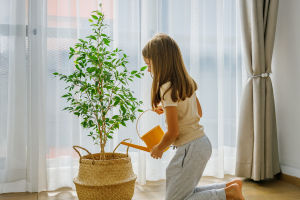
- Deep Saturation: Apply the "slow-drip method." Pour water slowly at the base until liquid begins to exit the drainage ports, indicating that the soil has reached full saturation (field capacity).
- Bottom Siphoning: For specimens with dense root structures, place the container in a shallow tray of water for 10–20 minutes. This utilizes capillary action to draw moisture upward into the root zone.
- Chemical Outgassing: Tap water often contains chlorine. Let your water sit for 12–24 hours, although many plants tolerate typical tap water levels.
Environmental Hardware Specs
A plant's hydration demand is a dynamic variable influenced by the "hardware" of your home—lighting intensity, airflow, and container porosity.
If you are using glazed ceramic or plastic containers, the non-porous walls trap moisture, extending the "evaporation cycle" and requiring a lower frequency of intervention. Conversely, unglazed terracotta acts as a breathable membrane, allowing moisture to escape through the walls. In low-humidity indoor circuits, transpiration increases, and the root-zone demand spikes. You must adjust your SOP based on these atmospheric loads. Use a hygrometer to track humidity; if it drops below 30%, you are not just watering a plant—you are fighting an atmospheric vacuum that is pulling moisture out of the leaves faster than the roots can resupply it.
The Void and the Flow
Mastering plant care is about managing balance. A container filled entirely with water is a failing system because it lacks oxygen. Healthy roots require both air and water in proper proportion.
Plants teach us the discipline of observation and timing. They do not need constant attention—they need appropriate care at the right moment. When you learn proper watering practices, you respect the natural balance of a living system. Growth happens not through excess, but through precision and consistency.