Lykkers, have you ever wondered why Earth has a magnetic field? It’s easy to take it for granted, but this invisible force protects all life on our planet.
If Earth’s magnetic poles suddenly flipped, migrating birds could get lost, electronics might fail, and the solar wind could start stripping away our atmosphere.
Life as we know it could face unimaginable challenges. In this article, we’ll explore why Earth has a magnetic field, its crucial roles, potential changes, and even how we humans unconsciously rely on it every day.
Why Earth Has a Magnetic Field
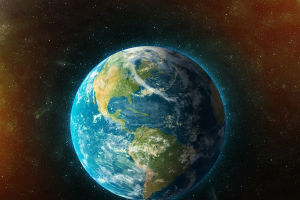
Earth behaves like a giant magnet. Its geographic North Pole is actually near the magnetic south, and the geographic South Pole is near the magnetic north. This magnetic field originates in the core, made mostly of iron, cobalt, and nickel, heated up to around 6000°C. At this extreme temperature, free electrons move rapidly, creating electric currents. Thanks to the principle of electromagnetism—electric currents generate magnetic fields and magnetic fields induce currents—Earth develops a massive, stable magnetic field.
The core is also constantly spinning, adding another layer of complexity. Interestingly, the flow of electrons is not fixed, yet today, the field points “north up, south down.” If the direction of electron movement changes, the magnetic field shifts too. Sometimes it just shifts slightly; other times, it could reverse entirely.
The Magnetic Field: Earth’s Protector
We often admire auroras, but Earth’s magnetic field does far more than light up the sky. The sun continuously emits high-energy particles known as the solar wind. Without a magnetic field, these charged particles could hit the atmosphere directly, stripping it away over time. Imagine Earth like an unpeeled orange—the skin represents the atmosphere. Remove it, and our water and surface conditions could vanish quickly.
Hydrogen in water is light and would escape into space, while oxygen might remain. Scientists believe Mars lost its water largely because it lost its magnetic shield. For 4.5 billion years, Earth’s magnetic field has kept our oceans intact, preserving life.
When solar wind interacts with the magnetic field, it deflects, creating stunning polar lights—auroras. This isn’t just beauty; it’s proof of the magnetic field’s protective role. Humans benefit too: the field shields our technology from harmful electromagnetic waves and reduces interference with power grids, pipelines, and communication systems.
What Happens If the Magnetic Poles Flip?
A magnetic reversal would shake Earth’s navigation. Birds, whales, and other creatures that rely on magnetic cues could get disoriented. Even human tools—GPS, compasses, and certain electronics—could malfunction.
During a reversal, the field’s intensity may weaken, leaving Earth temporarily exposed to solar wind. Water could break down, radiation levels rise, and technology could fail. Scientists warn this could be catastrophic for life, though the process usually happens gradually. Currently, Earth’s magnetic north and geographic north are about 11 degrees off, showing that the core is tilted and shifting continuously.
Earth has experienced roughly 171 pole reversals over 4.5 billion years, averaging one every 450,000 years. The next flip could occur anywhere, making any location a potential new pole. While the magnetic field could theoretically weaken if the core cools, it likely won’t disappear entirely because iron, cobalt, and nickel retain their magnetic properties.
How Humans and Animals Use the Magnetic Field
We’re not entirely separate from Earth’s magnetic field. Animals like cows, deer, and sheep align their bodies north-south when grazing. Humans may not notice it, but we are subtly influenced too. Even ancient house-building traditions that favor “north-south orientation” may reflect this alignment with the magnetic field. Compasses used in ancient design practices actually work because of Earth’s magnetic field.
On a micro level, our bodies contain iron and moving electrons. Interacting with the magnetic field can induce tiny currents in our bodies, affecting our biology in subtle ways. Ancient observations of building orientation and daily habits might not have been superstition—they were early recognition of the magnetic field’s influence on life.
Invisible but Vital
Though invisible, Earth’s magnetic field has quietly protected life for billions of years. It deflects harmful solar particles, stabilizes water resources, and even influences human and animal behavior. While magnetic poles may shift, as long as changes are gradual, life will continue. Lykkers, next time you see an aurora or use a compass, remember you’re witnessing a force that has safeguarded life on Earth for 4.5 billion years—and will continue to do so, quietly but powerfully.
Why Does Earth Have A Magnetic Field?
Video by Cosmoknowledge