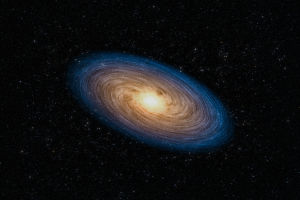
A cloud of gas and dust slowly spinning in space, billions of years ago.
This is how our Solar System started—an event that seems almost magical when you think about it. But this cloud, known as the solar nebula, wasn't just drifting aimlessly.
It was the birthplace of everything we know today: the Sun, the planets, and even the tiny asteroids.
Around 4.6 billion years ago, this nebula began collapsing under its own gravity. As it contracted, it heated up, and over time, the material clumped together to form the Sun at the center. But the story doesn't end there; the leftover material created the planets, moons, and other objects that make up our Solar System.
The Formation of the Sun
At the heart of this process is the Sun, which began its life as a massive ball of gas. The Sun's formation started when the pressure and temperature inside the nebula became high enough to trigger nuclear fusion. This process releases energy and is what powers the Sun to this day.
It's this energy that provided the initial "push" for the formation of the rest of the Solar System. The solar wind, which consists of charged particles released by the Sun, swept away lighter elements and pushed them outward, creating a distinct separation between the inner and outer planets.
The Birth of Planets: The Dust and Gas Cloud
As the gas and dust around the Sun continued to cool, it began to form solid particles. These particles collided and stuck together, creating larger bodies called planetesimals. These planetesimals were the building blocks of the planets.
In the inner part of the Solar System, where it was hotter, only metal and rock could condense, forming the rocky planets we know today: Mercury, Venus, Earth, and Mars. On the other hand, in the colder outer regions, gases like hydrogen and helium could also condense, leading to the formation of the gas giants—Jupiter, Saturn, Uranus, and Neptune.
1. Rocky Planets: Mercury, Venus, Earth, and Mars
2. Gas Giants: Jupiter, Saturn, Uranus, Neptune
The difference in materials between the inner and outer Solar System is a key reason for the stark contrast between the rocky and gas giants.
The Role of Collisions in Planet Formation
Planets didn't form in a quiet, peaceful way. Instead, they grew through a process called "accretion," where smaller planetesimals collided and merged. These collisions were violent and frequent in the early Solar System, leading to the formation of larger and larger bodies.
For instance, the Earth itself grew by the repeated impact of planetesimals. These impacts also helped to melt parts of the planets, leading to the formation of a core, mantle, and crust in Earth's structure. Over time, these impacts slowed, and the planets took on more stable orbits.
The Moon's Formation: A Celestial Collision
One of the most intriguing aspects of planet formation involves the creation of Earth's moon. Scientists believe that a Mars-sized body, named Theia, collided with the young Earth about 4.5 billion years ago. This massive impact ejected a huge amount of debris into space, which eventually coalesced to form the Moon.
This theory, known as the "Giant Impact Hypothesis," explains why the Moon and Earth have similar compositions. The collision also tilted Earth's axis, leading to the seasons we experience today.
The Final Stages: Clearing the Solar System
After the planets formed, the Solar System was still a chaotic place. There were leftover planetesimals and other debris still floating around. As the planets settled into their orbits, their gravitational forces began to clear out much of this leftover material.
This "cleaning up" process wasn't smooth. The gravitational pull of Jupiter, the largest planet, played a huge role in clearing out the asteroid belt. Some of these leftover objects became comets, which we still observe today.
The final shape of the Solar System took billions of years to fully settle, but what we see today is the result of this long process of formation, collision, and evolution.
Ongoing Discoveries: The Mystery of Planet Formation
Even with all that we've learned about the origins of our Solar System, there's still much to discover. Thanks to new technologies and space exploration missions, scientists are constantly uncovering new clues about the formation of planets, moons, and other objects.
For example, missions to the outer planets, like NASA's Voyager probes, have provided insights into the composition and characteristics of distant moons and rings. Scientists are also studying other star systems to learn if the process of planet formation is similar to our own.
The Impact of Our Solar System's Formation
Understanding the origins of our Solar System not only answers some of the most fundamental questions about our place in the universe, but it also provides important clues for the search for life elsewhere. By studying how planets form and the conditions that allow them to support life, we may one day discover whether we are truly alone in the universe.
The formation of our Solar System is a testament to the power of gravity, collisions, and time. What began as a cloud of gas and dust has evolved into the vibrant and dynamic system we call home, with eight planets, countless moons, and even more mysteries to explore.